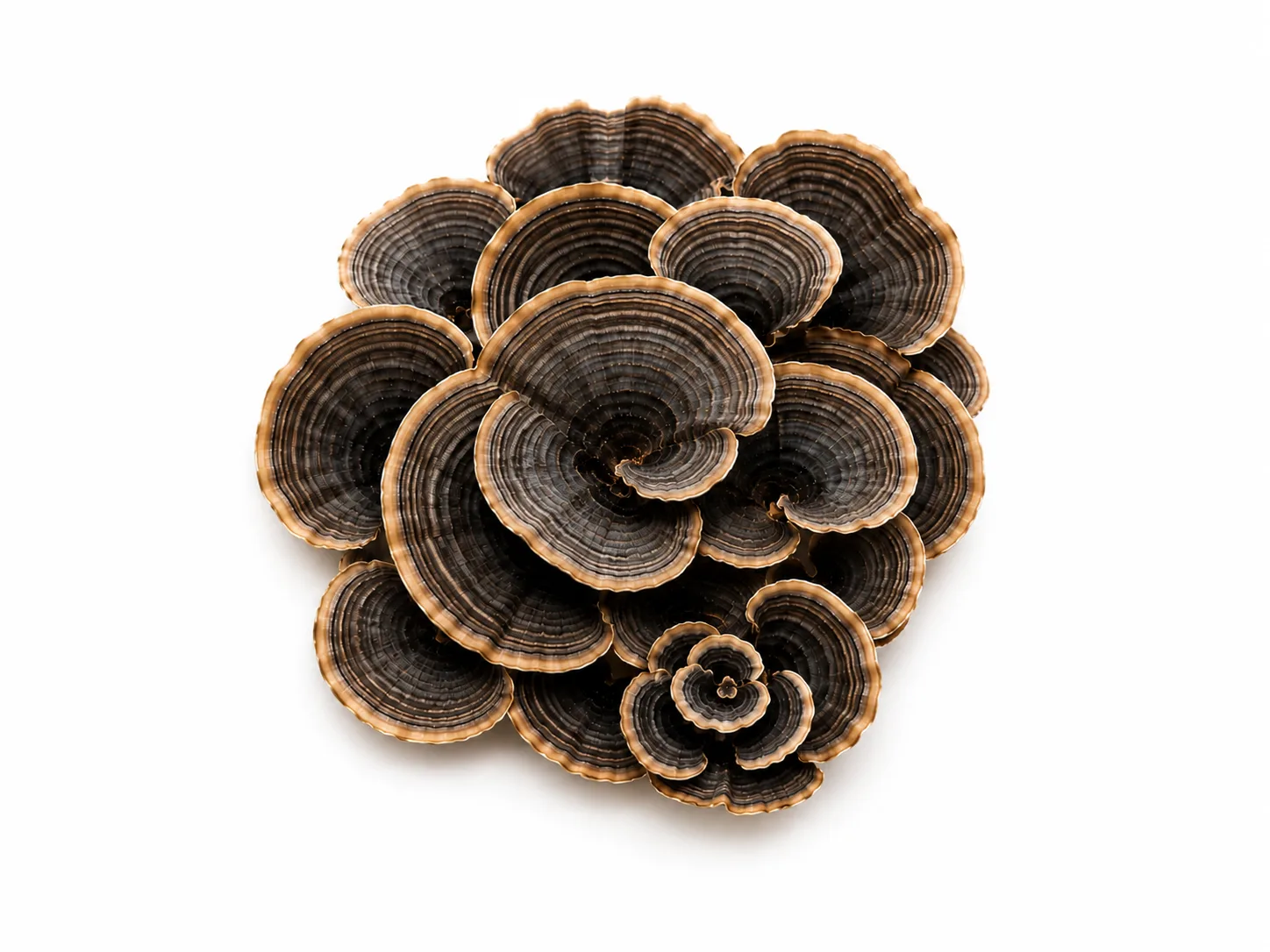
Trametes versicolor
Turkey Tail Ingredients with Fruiting Body Powder and Concentrated Extract Formats
Overview
Turkey Tail is often easy to romanticise through the language of wild collection, but raw material history in China has been more complicated than many buyers realise. For a long time, commercial Turkey Tail depended heavily on wild collection, which meant inconsistency, dependence on forest conditions, and growing concern over contamination risks.
For Biosan, the more important story is not that Turkey Tail was once wild-collected, but that it did not need to remain there. Biosan’s cultivated Trametes versicolor should be understood as part of a deliberate move away from unstable dependence on wild collection and toward a more controlled raw material route.
This page presents Turkey Tail as an ingredient category built around fruiting body relevance, cleaner sourcing logic, and practical commercial formats rather than borrowed prestige alone.
Available Product Forms
Additional standardised formats and detailed technical versions are available on request.
Note: Full specifications, ratios, and SKU codes are not published online. Use Request Documents for TDS, SDS, and COA samples.
Raw Material Background
Turkey Tail, known in Chinese as Yun Zhi, has long been used in East Asia, but commercial raw material history in China has been more complicated than many buyers realise. For a long time, Turkey Tail in China depended heavily on wild collection. In practice, this created obvious problems: inconsistency, dependence on forest conditions, and increasing concern over environmental contamination, including pesticide-related realities in forest systems.
Biosan’s cultivated Trametes versicolor line should therefore be presented as a meaningful shift rather than as a trivial supply detail. The value lies in moving away from unstable dependence on wild collection and toward a more controlled cultivated raw material route.
Processing Pathways
Turkey Tail is generally offered in powder and concentrated extract forms. Depending on the product objective, buyers may want stronger fruiting body presence, a more soluble extract, or a balance between soluble and structural fractions.
Traditional Use
In traditional Chinese and Japanese systems, Turkey Tail has long been associated with support for balance, recovery, and resilience. It is traditionally discussed more in relation to the Spleen and Lung systems than through modern clinical branding language.
Scientific / Research Context
Modern research around Turkey Tail often refers to polysaccharide-rich fractions and to PSP- and PSK-related discussions, but commercial products in the market vary greatly in source, processing route, and interpretation.
Quality & Documentation
Technical documents for Turkey Tail powder and extract formats are available on request. Biosan can also explain how different Turkey Tail formats relate to raw material sourcing, extract logic, and documentation needs.
FAQ
Which Turkey Tail formats does Biosan offer?
Options include fruiting body powder and concentrated extract. Request the current specification and confirm availability for the format you need.
Is a Turkey Tail extract the same as PSK or PSP?
No. PSK and PSP evidence cannot automatically substantiate an ordinary Turkey Tail ingredient. [S22]
How should Turkey Tail identity be assessed?
Ask for a material-appropriate identity assessment; a single barcode may not resolve all closely related Trametes species. [S22]
Does a cultivated Turkey Tail source remove the need for safety testing?
No. Cultivated material still needs source controls and a suitable safety assessment. [S19]
What should I include in a Turkey Tail enquiry?
Specify species, fungal material, format, method, composition restrictions and market; identify any PSK or PSP research reference.
Related Resources
Need Specifications, Documents, or Product Guidance?
If you are evaluating mushroom ingredient options for your market, product line, or formulation work, our team can help you review available formats and provide the relevant technical documents on request.